Martha Divakar · March 27, 2026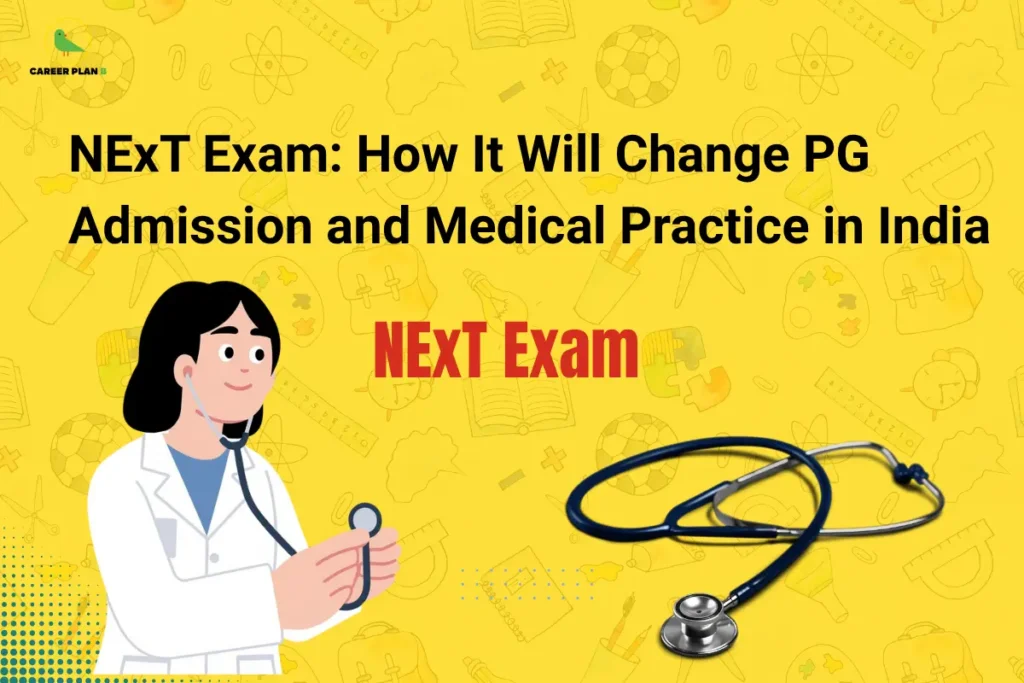
Introduction
Imagine clearing your MBBS after years of hard work – only to face two more high-stakes exams. One to earn your PG seat. Another just to practice medicine legally. Sounds exhausting, right?
That is exactly the problem India’s National Exit Test (NExT) is designed to solve. Introduced under the NMC Act 2019, NExT is a single, unified exam built to serve three purposes at once: granting a medical license, determining PG admission merit, and replacing the FMGE for foreign medical graduates.
It is one of the boldest reforms in Indian medical education in decades. But what does it actually mean for you — whether you are a final-year MBBS student, a PG aspirant, or a foreign medical graduate returning home? Let us break it down.
What Exactly Is the NExT Exam?
The National Exit Test is a standardized, national-level exam that every MBBS graduate must clear before they can practice medicine in India. It acts as both a licensing exam and a PG entrance exam — two birds, one stone.
Think of it as the medical equivalent of a board exam and an entrance test rolled into one clean package.
NExT Step 1 — Theory
Step 1 is a Computer-Based Test (CBT) covering both clinical and preclinical subjects from across the MBBS curriculum. It is MCQ-based and taken after the completion of final-year MBBS. Crucially, your Step 1 score will determine your PG admission rank — making it the single most important exam of your medical career.
NExT Step 2 — Clinical and Practical
Step 2 is a practical, skills-based assessment. Candidates become eligible for Step 2 only after completing their 12-month internship. This component tests real-world clinical ability — how well you can actually examine, diagnose, and manage patients — moving the focus far beyond rote memorization.
Struggling to understand the PG Admission trends? Don’t stay stuck.
How NExT Will Change PG Admissions
This is where NExT becomes a true game-changer for Indian medical students.
Once fully implemented, there will be only one exam standing between you and a PG seat. Your NExT Step 1 score will serve as your PG merit rank — eliminating the need for a separate NEET PG exam after internship. The exhausting cycle of appearing for multiple sequential exams, year after year, is set to end.
This also makes the system more equitable. Today, students from well-resourced colleges with access to premium coaching often have a structural advantage in NEET PG. A single standardized national exam shifts the focus back to genuine knowledge and clinical competence — not the depth of your coaching budget.
For foreign medical graduates, the change is equally significant. Currently, they must clear the FMGE — a notoriously tough screening exam — before they can practice in India. Under NExT, the FMGE will be abolished. Foreign graduates will instead appear for the same NExT exam as Indian graduates, on the same terms, within two years of completing their MBBS abroad.
One exam. One standard. One system for everyone.
Impact on Medical Practice and Licensing
NExT is not just an entrance reform — it is a quality reform for Indian healthcare.
By making clinical skills a graded, mandatory component through Step 2, NExT fundamentally shifts how India assesses its doctors. The current system heavily rewards the ability to recall facts under pressure. NExT rewards the ability to actually think and act like a doctor.
Both Indian and foreign medical graduates will face the same national competency benchmark before receiving a license. This means patients across India — whether in a metro hospital or a rural clinic — can trust that every licensed doctor has met the same minimum standard of knowledge and skill.
For the overall quality of healthcare in India, that is a meaningful step forward.
Current Status: Where Does NExT Stand in 2026?
Here is the most important thing every medical student needs to know right now: NExT has not yet been implemented.
The National Medical Commission officially deferred full rollout, pushing implementation back to approximately 2028 or 2029. Students graduating in the 2025–26 cycle will continue to appear for NEET PG as their PG entrance exam. The 2020 and 2021 MBBS batches are largely exempt from NExT Step 1 for PG purposes.
A trial or mock NExT exam may be conducted in medical institutions sometime in 2026 or 2027, subject to NMC approval. The commission has made clear that it wants to perfect the model before a full national rollout — prioritizing accuracy over speed.
So where does that leave you?
- Graduating in 2025–26? Prepare for NEET PG. That remains your exam.
- In earlier MBBS batches? NExT will be your reality — start understanding it now.
- A foreign medical graduate? Continue preparing for FMGE for now, but watch the NMC timeline closely.
The landscape is shifting. Students who understand the direction of change — and plan accordingly — will always be better positioned than those who wait for the dust to settle.
How Career Plan B Supports Every Step
- Personalized Counseling: In-depth one-on-one counseling to align specialization, college choices, and career goals.
- Timeline & Reminder Service: Never miss a deadline—receive timely reminders and updates about institute-wise counseling calendars.
- Document Checklist & Verification: Guidance to prepare all required documentation, reducing stress on D-day.
- Preference Analysis: Analysis of seat trends, cut-offs, and college quality to build a winning choice list.
- Mock Counseling & Strategy: Practice sessions to simulate real counseling—boosting your confidence, reducing errors.
- Support for Appeals/Technical Issues: Help in resolving portal issues, appeals, or queries with admission authorities.
Have any doubts?
Frequently Asked Questions
- Will NExT completely replace NEET PG?
Yes — but not immediately. NExT has been postponed for at least three to four years, so NEET PG will continue as the standard PG entrance exam through 2026 and beyond. Once NExT is implemented, it will serve as the single exam for both licensing and PG admissions.
- Who needs to appear for NExT?
All MBBS graduates from NMC-approved institutions in India, as well as foreign medical graduates who wish to practice in India, will need to clear NExT. It applies to both Indian and foreign-trained doctors equally.
- Is NExT harder than NEET PG?
It is more comprehensive rather than simply harder. The addition of a mandatory clinical skills component in Step 2 makes NExT a more well-rounded assessment. Experts consider it more demanding than FMGE, as it is designed to produce doctors who are both knowledgeable and clinically competent.
- What happens to FMGE once NExT is implemented?
FMGE will be abolished and replaced by NExT. Foreign medical graduates will no longer need to clear a separate screening exam — they will appear for the same NExT exam as Indian graduates. For now, FMGE remains the operative screening exam until NExT is officially rolled out.
- When will NExT actually be implemented?
Based on current NMC communication, full implementation is expected around 2028 or 2029, beginning with the MBBS batch of 2024 who will graduate around that time. Students are advised to track NMC announcements regularly for updates.
Conclusion :
NExT is not just a new exam — it is a fundamental rethinking of how India trains, tests, and licenses its doctors. By merging licensing, PG admission, and FMGE screening into one standardized framework, it promises a fairer, more competency-driven medical system for the country.
For students graduating in 2025–26, the immediate focus remains NEET PG. But for those in earlier batches, NExT is on the horizon, and building a clear plan now will always be better than scrambling later.
Confused about your next steps? Get a personalized roadmap tailored to your career goals.