Piyush · April 7, 2026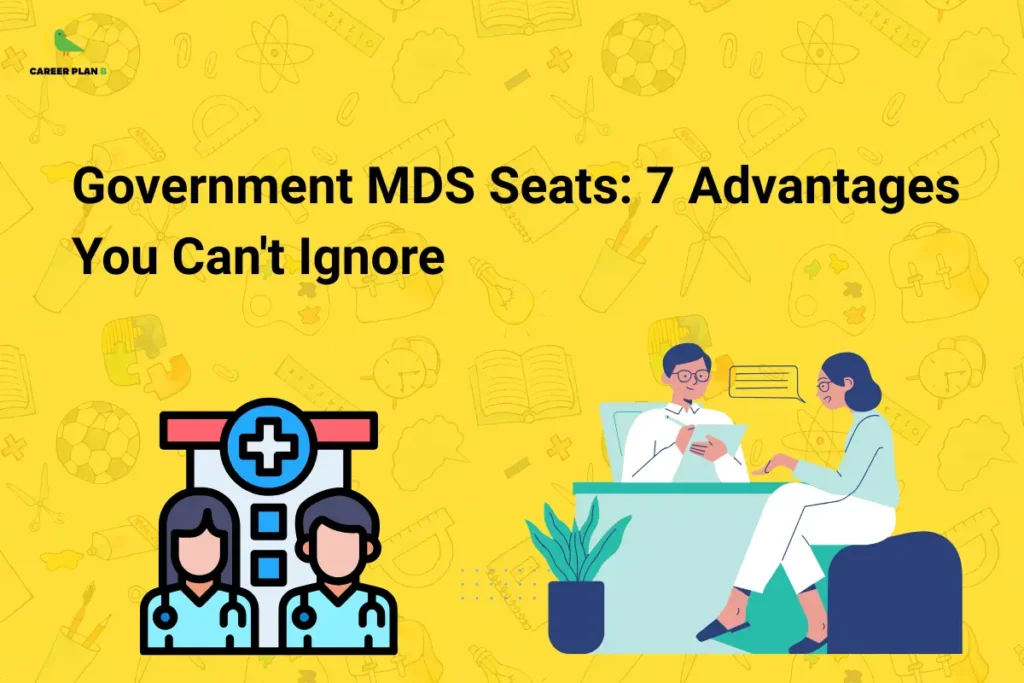
Introduction
Every year, thousands of BDS graduates sit for NEET MDS with one clear goal — securing a government MDS seat. But have you ever wondered why the competition is so intense? Why do so many dental graduates spend months, sometimes years, preparing to crack this single exam?
The answer is simple: a government MDS seat is not just an admission letter. It is a career-defining opportunity.
Whether you are just finishing your BDS internship or are already deep into NEET MDS preparation, understanding the real advantages of government dental colleges can help you stay motivated and make a smarter decision about your future.
What Are Government MDS Seats?
MDS, or Master of Dental Surgery, is the primary postgraduate degree for dental specialisation in India. Government MDS seats are offered through government dental colleges and are allotted via NEET MDS scores, followed by centralised counselling through MCC (All India Quota) or state-level counselling bodies.
These seats are limited, competitive, and — as you will soon see — incredibly valuable.
Confused about your next steps? Get a personalized roadmap tailored to your career goals.
Top Advantages of Choosing Government MDS Seats
1. Significantly Lower Tuition Fees
Let’s start with the most obvious advantage: the cost.
Tuition fees at government dental colleges for MDS are a fraction of what private institutions charge. While private MDS colleges can charge anywhere between ₹20 lakh to ₹80 lakh or more for the full course, government MDS seats typically cost between ₹1 lakh to ₹5 lakh in total — sometimes even less.
For most Indian families, this difference is life-changing. It means completing your dental specialisation without crippling education loans or financial stress, allowing you to focus entirely on your training.
2. High Academic Credibility and Recognition
Government dental colleges, particularly those attached to large teaching hospitals, carry strong academic reputations. Degrees from institutions like Maulana Azad Institute of Dental Sciences (Delhi), Government Dental College Mumbai, or KGMC Lucknow are widely respected by employers, hospitals, and academic institutions across India and abroad.
When you apply for faculty positions, hospital jobs, or even international licensing exams, the name of your institution matters. A government MDS degree adds genuine weight to your profile.
3. Superior Clinical Exposure
One of the biggest advantages of government dental colleges is the sheer volume of patients. Government hospitals attached to dental colleges see a significantly higher patient footfall compared to most private setups. This means more hands-on cases, more complex procedures, and more real-world clinical experience during your three years of training.
For a dental specialist, clinical exposure is everything. The more you see and do during your postgraduation, the more confident and competent you become as a practitioner.
4. Stipend During the Course
Here is something many BDS students do not realise until later: most government MDS programmes offer a monthly stipend to their postgraduate students.
While the amount varies by state and institution, it typically ranges from ₹15,000 to ₹35,000 per month. This is not just pocket money — it meaningfully reduces the financial burden on students and their families throughout the course.
Compare this with private colleges, where students are paying fees and earning nothing, and the advantage becomes very clear.
5. Stronger Placement and Career Opportunities
Graduating from a reputed government dental college opens doors that are otherwise harder to access. Faculty recruitment in dental colleges, specialist roles in government hospitals, Armed Forces dental positions, and competitive international opportunities all tend to favour candidates with strong academic backgrounds from recognised institutions.
Additionally, the rigorous training environment at government colleges often produces more well-rounded specialists, which reflects positively during interviews and licensing processes.
6. A Peer Network That Pushes You to Grow
When you secure a government MDS seat, you are surrounded by some of the most dedicated and high-performing dental graduates in the country. These are people who competed fiercely and earned their place.
This environment builds a culture of academic rigour and professional seriousness that shapes you beyond the classroom. The peer network you build during your MDS can support your career for decades — through referrals, collaborations, and shared opportunities.
Private vs Government MDS — A Quick Comparison
| Parameter | Government MDS | Private MDS |
|---|---|---|
| Tuition Fees | ₹1–5 lakh (approx.) | ₹20–80 lakh (approx.) |
| Monthly Stipend | Yes (most colleges) | Rarely offered |
| Clinical Exposure | High (large patient volume) | Varies widely |
| Academic Recognition | Nationally strong | Varies by institution |
| Admission Route | NEET MDS + Counselling | NEET MDS + Management quota |
How Career Plan B Helps
Cracking NEET MDS and securing a government seat require more than hard work – they require a clear strategy.
Career Plan B offers personalised career counselling and career roadmapping to help dental graduates navigate MDS admission in India with confidence.
From understanding your options to building a strong academic profile, Career Plan B guides you at every step of your dental postgraduate journey.
For Latest Information
Frequently Asked Questions
Q1. Are government MDS seats available through the All India Quota?
Yes. A percentage of government MDS seats are allotted through the All India Quota (AIQ) via MCC counselling, while the remaining seats are filled through state counselling based on NEET MDS scores.
Q2. Is the stipend guaranteed in all government dental colleges?
Most government dental colleges offer a stipend, but the amount and availability can vary by state and institution. It is advisable to check with the specific college during counselling.
Q3. How competitive is it to get a government MDS seat?
Very competitive. With a limited number of seats and thousands of applicants each year, a strong NEET MDS score and thorough preparation are essential.
Q4. Can I choose my specialisation in government MDS counselling?
Yes, but it depends on your NEET MDS rank and seat availability. Higher-ranked candidates get more choice of both college and specialisation during counselling rounds.
Conclusion
A government MDS seat is worth every bit of the effort it takes to earn one. Lower fees, a monthly stipend, outstanding clinical training, and strong career prospects make it the smartest path for dental post-graduation in India – if you are willing to prepare seriously and compete hard.
The journey starts with a decision: to go after the best, not just the easiest.
If you are ready to build a clear roadmap for your MDS admission, Career Plan B is here to help you get there.