Likhith · March 27, 2026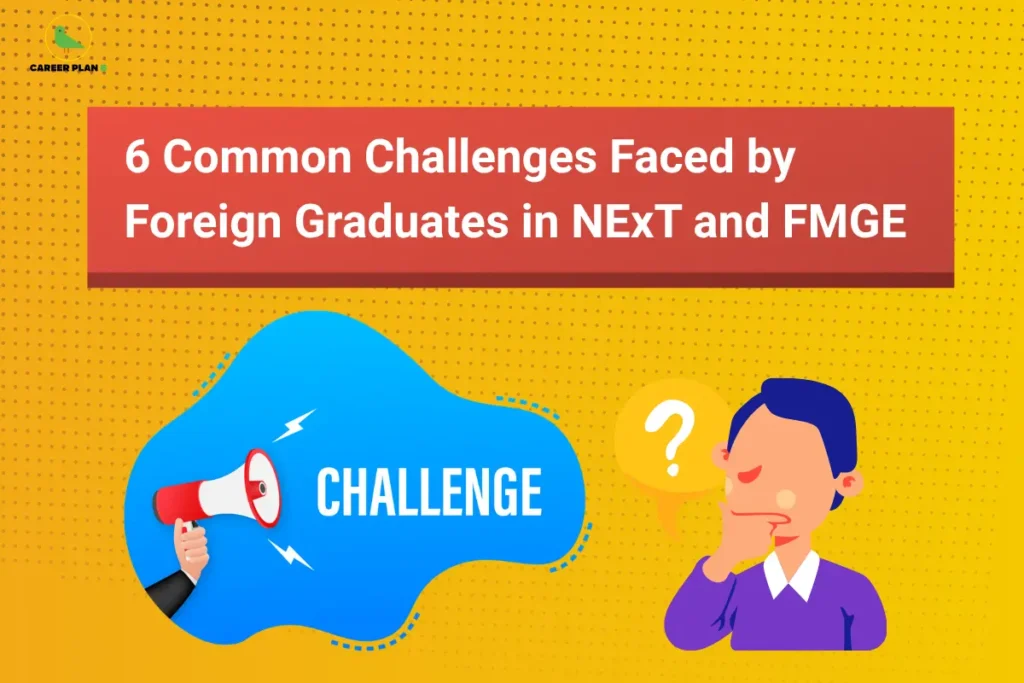
Introduction
Imagine spending five or six years earning your medical degree abroad — in Russia, China, Ukraine, or the Philippines — only to return home to India and face an entirely new test before you can even begin practising. For thousands of foreign medical graduates every year, this is not a hypothetical. It is their reality.
The Foreign Medical Graduate Examination (FMGE) and its successor, the National Exit Test (NExT), are mandatory licensing exams that every foreign-trained doctor must clear to practise medicine in India. And while these exams exist for good reason — to maintain the standard of healthcare — they present a unique and steep set of challenges for foreign graduates that go far beyond simply “studying harder”.
In this blog, we break down the most common challenges faced by foreign medical graduates in NExT and FMGE, and what you can do to navigate them successfully.
What Are NExT and FMGE? A Quick Overview
The FMGE (Foreign Medical Graduate Examination) is a screening test conducted by the National Board of Examinations (NBE) that foreign medical graduates must pass to obtain a licence to practise in India.
The NExT (National Exit Test) is set to replace both FMGE and the final-year MBBS exams, creating a unified licensing exam for all medical graduates — Indian and foreign alike. While the transition is still underway, foreign graduates must stay updated on which exam applies to them based on their year of enrollment.
Why Do Foreign Graduates Struggle More Than Others?
Here is the core problem: foreign medical graduates are trained under a different country’s curriculum, but they are tested on India’s National Medical Commission (NMC) syllabus. This gap – between what they studied and what they are examined on – is at the heart of most challenges they face in NExT and FMGE.
Let us look at each challenge in detail.
Common Challenges Faced by Foreign Medical Graduates
1. Curriculum Mismatch and Syllabus Gaps
- Foreign medical universities (e.g., Russia, China) follow their own national curriculum, which differs from the NMC syllabus in India.
- Certain topics studied abroad may be:
- Covered in great depth, or
- Barely addressed at all compared to Indian standards.
- Subjects like Pharmacology, Pathology, and Community Medicine often show major differences.
- Students need to re-learn subjects from an Indian exam perspective, not just revise.
- The challenge is not about intelligence, but a lack of aligned academic exposure.
2. Language and Communication Barriers
- Many students study in environments where:
- English is not the primary language, or
- Teaching is a mix of English + local language.
- Clinical training in countries like China/Russia often happens in the local language.
- This leads to:
- Slower reading speed
- Reduced comprehension in English
- Difficulty in interpreting clinical case-based questions
- Exams like FMGE/NExT rely heavily on case-based understanding, making language a key factor.
3. Lack of Structured Preparation Guidance
- Unlike NEET-PG/USMLE aspirants, FMGs often lack:
- Coaching support
- Peer study groups
- Mentorship guidance
- Many students:
- Study without prioritisation, or
- Follow generic study plans not suited to their gaps
- Common consequences:
- Wasted time and effort
- Confusion in preparation strategy
- Slow progress and frustration
4. Low Pass Rates and Exam Pressure
- FMGE has a very low pass rate (15–20%).
- This means:
- Around 4 out of 5 candidates fail in the first attempt.
- Creates multiple pressures:
- Fear of failure
- Financial burden (due to repeated attempts)
- Delay in career progression
- Emotional impact:
- Stress
- Anxiety
- Loss of confidence
- This psychological pressure can directly affect exam performance.
5. Uncertainty Around the NExT Transition
- Transition from FMGE to NExT has caused:
- Confusion about exam pattern
- Uncertainty about eligibility and timelines
- Key concerns among students:
- Will they appear for FMGE or NExT?
- How will scoring and ranking work?
- What happens to internship requirements?
- Lack of clear communication from authorities leads to:
- Delayed preparation decisions
- Difficulty committing to a study plan
- Result: Valuable preparation time is lost
6. Limited Clinical Exposure in India
- Clinical training abroad often differs from India in:
- Disease patterns
- Treatment protocols
- Drug availability
- Patient demographics
- Challenges faced after returning:
- Difficulty adapting to Indian clinical scenarios
- Issues with internship recognition
- Limited access to hands-on hospital experience
- Without Indian clinical exposure:
- Concepts remain theoretical
- Students struggle with application-based questions in exams
How Career Plan B Helps
Navigating NExT and FMGE as a foreign medical graduate does not have to be a solo journey. \
Career Plan B offers personalised career counselling and career roadmapping designed specifically for students at crossroads like these.
With tools like Psycheintel and Career Assessment Tests, students gain clarity on their strengths, study patterns, and the right path forward, so every step is intentional, not accidental.
Have any doubts?
Frequently Asked Questions
Q1. Is FMGE being replaced by NExT?
Yes. The National Exit Test (NExT) is designed to replace FMGE for foreign medical graduates and the final MBBS exam for Indian graduates. The timeline for full implementation is still being rolled out by the NMC.
Q2. What is the pass percentage of FMGE?
Historically, the FMGE pass rate has been between 15% and 20%, making it one of the more challenging licensing exams. Structured preparation significantly improves your chances.
Q3. How many attempts are allowed for FMGE or NExT?
Currently, there is no cap on the number of attempts for FMGE. NExT attempt limits are still being defined by the NMC — it is important to check the latest official guidelines.
Q4. Can a foreign medical graduate practise in India without clearing NExT or FMGE?
No. Clearing either FMGE or NExT (depending on your enrollment year) is mandatory to obtain a licence to practise medicine in India.
Q5. How should a foreign medical graduate begin preparing for NExT or FMGE?
Start by identifying your syllabus gaps, then build a subject-wise study plan aligned with the NMC curriculum. Focus on high-yield subjects, practice clinical case-based questions, and seek structured guidance early.
Conclusion
Clearing NExT or FMGE as a foreign medical graduate is challenging – but it is absolutely achievable with the right awareness, preparation, and support. The challenges are real: curriculum gaps, language barriers, low pass rates, and exam uncertainty can make the journey feel overwhelming. But understanding these hurdles is the first step to overcoming them.
You did not come this far to stop here. With a structured roadmap, honest self-assessment, and the right guidance, your Indian medical career is well within reach.
Ready to take the next step with clarity and confidence? Reach out to Career Plan B today and get the personalised support you deserve.