Likhith · August 10, 2025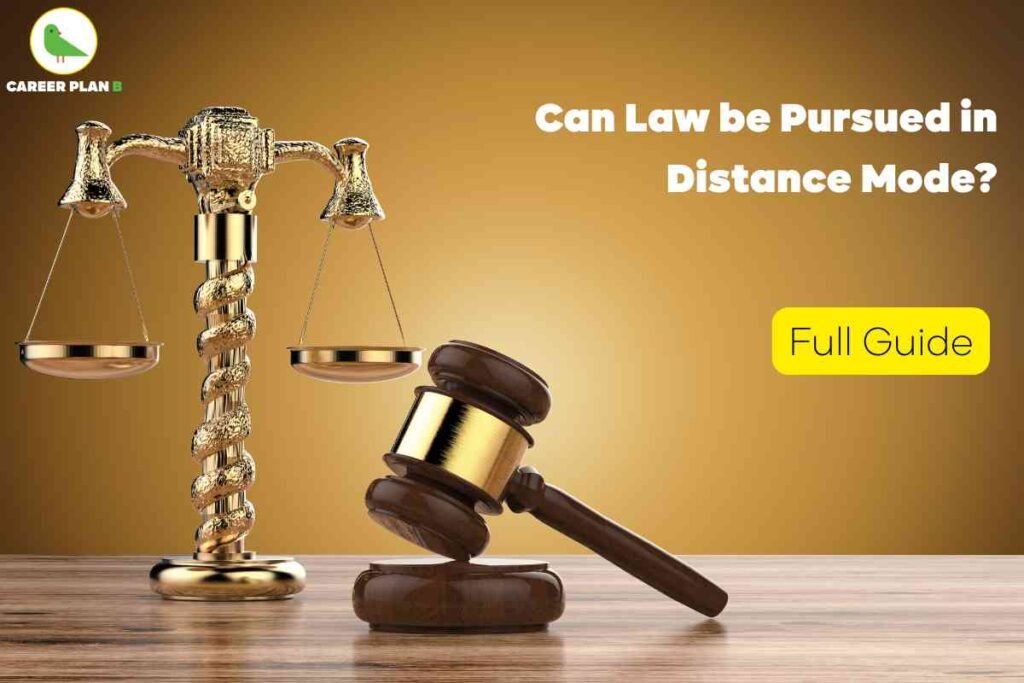
Introduction
Every year, thousands of working professionals, graduates, and career changers search for a way to study law without sitting in a classroom full-time. The appeal is obvious: flexibility, lower costs, and no need to pause your career or other commitments.
But the answer to whether law can be pursued in distance mode in India is not simple. The short version is this: you can study law-related courses through distance education, but a distance LLB does not allow you to practice law in Indian courts. This distinction matters enormously, and most articles on this topic fail to explain it clearly.
This guide gives you the complete picture for 2026, covering what the Bar Council of India actually says, which distance law courses are genuinely useful, who should consider them, and what your real alternatives are if you want to become a practicing advocate.
What the Bar Council of India Says About Distance LLB
The Bar Council of India (BCI) is the statutory body that regulates legal education and the legal profession in India under the Advocates Act, 1961. Its position on distance legal education is unambiguous and has not changed.
The BCI’s Official Stance
The Bar Council of India does not recognize LLB degrees obtained through distance, correspondence, online, part-time, or evening modes for the purpose of enrolling as an advocate and practicing law in Indian courts.
This rule was formally established through the BCI Rules of Legal Education (2008) and later reinforced through the Ministry of Law and Justice, which confirmed that BCI does not recognize evening, night-school, part-time, or distance LL.B. courses started after the academic year 2000 to 2001.
The implications are significant:
- A student who completes a distance LLB from any Indian university cannot enroll with any State Bar Council
- Such a student is ineligible to appear for the All India Bar Examination (AIBE)
- Without AIBE qualification, they cannot legally practice in any court in India
Why BCI Mandates Full-Time, Regular LLB
The BCI’s insistence on regular, in-person legal education is not bureaucratic rigidity. It is grounded in the nature of legal training itself.
BCI’s Rules of Legal Education mandate that every law student must:
- Maintain a minimum of 70% attendance in all classes
- Participate in moot court sessions and simulated court proceedings
- Complete mandatory internships with advocates, courts, or law firms
- Undergo clinical legal education, including live client interaction and legal aid work
None of these requirements can be authentically fulfilled through correspondence or online formats. Legal reasoning, advocacy, cross-examination technique, and court decorum are skills that develop through practice, observation, and mentored experience, not self-study alone.
What Happens If You Complete a Distance LLB?
This is a critical question, because many institutions continue to offer distance LLB programs despite BCI’s position. Here is what you need to know:
You Cannot Practice in Courts
The most important consequence: a distance LLB holder cannot enroll as an advocate with any State Bar Council. Without Bar Council enrollment, you cannot appear in any court of law in India, from a district court to the Supreme Court.
You Cannot Appear for AIBE
The All India Bar Examination is the mandatory licensing exam for all law graduates who wish to practice. Eligibility for AIBE requires a BCI-recognized law degree from a full-time, approved institution. Distance LLB graduates are not eligible.
Your Degree Has No Legal Practice Value
While the degree itself may be awarded by a recognized university (such as a state university operating through its distance education division), the degree is not the same as a BCI-approved qualification. Possession of the degree does not entitle you to any legal practice rights.
You May Still Use It for Non-Practice Purposes
This is the nuance that matters. A distance LLB or law diploma, while ineligible for court practice, can still be useful for:
- Government jobs that require legal knowledge but not bar enrollment (compliance roles, legal advisors in public sector)
- Civil services preparation (UPSC and state PSC exams)
- Academic or research roles
- Corporate and HR functions requiring knowledge of labour law, contract law, or intellectual property
Recognized Distance and Online Law Courses in India (2026)
While a full LLB cannot be done through distance mode for practice purposes, there is a legitimate category of distance law education: postgraduate diplomas and certificate programs in specialized areas of law. These are offered by recognized universities, are UGC-approved, and serve a genuine purpose for professionals who need legal literacy without courtroom ambitions.
Institutions Offering Distance Legal Education
IGNOU (Indira Gandhi National Open University)
IGNOU offers several law-related programs through distance mode that are UGC-recognized and widely respected:
- PG Diploma in Cyber Law
- PG Diploma in Intellectual Property Rights
- PG Diploma in Human Rights
- Certificate Program in Consumer Protection Law
Annamalai University
Offers distance legal diplomas through its Directorate of Distance Education. Frequently chosen by working professionals in Tamil Nadu and other southern states.
Symbiosis Centre for Distance Learning (SCDL)
Offers PG diplomas in Business and Corporate Laws, Labour Laws, and related areas that are valued in corporate HR and compliance roles.
National Law School of India University (NLSIU), Bengaluru
Offers specific executive programs and diploma courses in law through distance and online formats for working professionals. These are not LLB programs but are highly regarded for their content and institutional reputation.
Dr. Ambedkar Law University
Offers distance programs in legal areas for professionals and researchers.
Types of Courses Available Through Distance Mode
| Course Type | Duration | Who It Is For |
|---|---|---|
| PG Diploma in Cyber Law | 6 to 12 months | IT professionals, compliance officers |
| PG Diploma in IPR (Intellectual Property Rights) | 6 to 12 months | Inventors, designers, corporate teams |
| PG Diploma in Labour and Industrial Laws | 6 to 12 months | HR managers, factory supervisors |
| PG Diploma in Human Rights | 6 to 12 months | NGO workers, journalists, researchers |
| PG Diploma in Consumer Protection | 6 months | Consumer advocates, entrepreneurs |
| PG Diploma in Corporate Law and Practice | 1 year | Finance and legal corporate professionals |
| Certificate in Business Laws | 3 to 6 months | Small business owners, managers |
These programs do not qualify you to practice in courts but provide genuine legal knowledge applicable across business, government, research, and social work contexts.
LLB vs. Distance Legal Diplomas: Clear Comparison
| Feature | Regular LLB (Full‑Time) | Distance Legal Diplomas |
|---|---|---|
| BCI Approved | Yes | No (for practice) |
| Eligible for Court Practice | Yes | No |
| Eligible for AIBE | Yes | No |
| Bar Council Enrollment | Yes | No |
| Duration | 3 years (after graduation) or 5 years (after Class 12) | 6 months to 1 year |
| Admission Requirement | Class 12 (5‑yr) or Graduation (3‑yr) | Generally graduation |
| Mode | In‑person, full‑time | Online or correspondence |
| Best Suited For | Aspiring advocates and judges | Professionals needing legal literacy |
| Career Value | Full legal career possible | Enhanced professional credibility |
Who Should Consider Distance Legal Education?
Distance law courses are not second-best options. For the right people, they are the most appropriate and efficient choice. Here is who genuinely benefits:
Working Professionals Who Need Legal Knowledge
HR managers dealing with labour law disputes, compliance officers managing regulatory requirements, finance professionals handling contracts, and operations managers navigating business law situations all benefit significantly from a focused diploma in the relevant area of law.
Civil Services Aspirants
UPSC and state PSC examinations frequently test candidates on constitutional law, administrative law, and fundamental rights. A PG diploma from a reputed distance institution can deepen your understanding without requiring you to enroll in a full three-year program.
Journalists, Activists, and NGO Workers
Understanding human rights law, media law, or public interest litigation does not require a full law degree. Distance diplomas give these professionals the legal grounding they need to work more effectively.
Entrepreneurs and Small Business Owners
Business law, intellectual property, and contract law knowledge protects your business interests and helps you make better decisions without paying lawyers for every question.
Researchers and Academics
If you are pursuing a PhD in law or social sciences, or teaching at a college, a distance diploma adds substantive legal depth to your work without requiring full-time enrollment.
Alternatives If You Want to Actually Practice Law
If your goal is to practice as an advocate in Indian courts, there is no shortcut. The path is clear:
Option 1: Regular 5-Year Integrated LLB (After Class 12)
The BA LLB, BBA LLB, B.Com LLB, and B.Sc LLB integrated programs run for five years and are the standard entry point for students entering law directly after Class 12. CLAT (Common Law Admission Test) is the primary entrance exam for the National Law Universities (NLUs). State-level law CETs are available for other approved institutions.
This is the most efficient path for students who know they want a legal career from early on.
Option 2: Regular 3-Year LLB (After Graduation)
Graduates from any discipline can pursue a three-year LLB from a BCI-approved law school. This path suits working professionals who want to formally transition into law after building experience in another field.
Many advocates practicing today completed a 3-year LLB after years in business, engineering, medicine, or government service. The combination of domain expertise and legal training is increasingly valued.
Option 3: LLM (Master of Laws) After LLB
For those who have already completed a regular LLB and want to specialize, LLM programs at National Law Universities and leading private law schools offer deep expertise in areas like corporate law, criminal law, constitutional law, and international law.
Option 4: Judicial Services Examination
Beyond advocacy, law graduates can appear for the Judicial Services Examination in their state to become civil judges. This path requires a full-time BCI-recognized LLB as a prerequisite.
Learn more about how career counseling for students considering law can help you map the right path based on your background and goals.
How Career Plan B Helps
Choosing between a full-time law degree, a distance diploma, or an entirely different career path is not a decision to make based on a quick internet search. The right choice depends on what you actually want to do with your career, not just what is convenient right now.
Career Plan B works with students and professionals who are weighing law as a career option. Here is how we help:
- Career Assessment — Understand whether law as a profession (advocacy, judiciary, corporate law) is genuinely aligned with your strengths, interests, and long-term goals, before you commit to a three to five year program.
- Law School Selection Guidance — If you decide to pursue a regular LLB, we help you identify the right institutions based on your CLAT score, state law CET performance, budget, and career objectives.
- Alternatives Mapping — For those who need legal knowledge without a full degree, we identify the most valuable distance diplomas and certifications based on your specific professional context.
- Working Professional Counseling — If you are already employed and considering a shift into law, we help you assess whether a 3-year LLB is the right investment, and how to manage the transition practically.
- One-on-One Sessions — A certified counselor takes the time to understand your specific situation and gives you a personalized roadmap rather than generic advice.
Frequently Asked Questions
1.Is IGNOU LLB valid for Bar Council enrollment?
IGNOU does not offer an LLB program. It offers law-related postgraduate diploma programs, which are not equivalent to an LLB and do not qualify you for Bar Council enrollment or AIBE. IGNOU’s law diplomas are valid for non-practice purposes only.
2.Can I do LLB online in India?
As of 2026, the Bar Council of India has not approved any fully online LLB program for the purpose of legal practice. Even online programs offered by otherwise reputed universities do not meet BCI’s requirement for physical attendance, moot courts, and clinical legal education.
3.Is a distance law diploma useful for government jobs?
Yes, for certain roles. Government departments, public sector undertakings, and regulatory bodies often have non-advocate legal roles (legal advisors, compliance officers, drafting assistants) where a degree or diploma in law adds value. However, for roles that require Bar Council enrollment or legal practice, only a regular BCI-approved LLB qualifies.
4.What is the minimum attendance required for a regular LLB?
The Bar Council of India mandates a minimum of 70% attendance for all law students in BCI-approved institutions. This is one of the primary reasons distance education is incompatible with LLB requirements.
5.Can I do LLB part-time while working?
BCI does not recognize part-time or evening LLB programs started after 2000 to 2001. A small number of institutions offered part-time programs before this cutoff, but those qualifications are not available to new students. The only BCI-recognized path is full-time, in-person regular LLB.
6.What is the difference between a BA LLB and a standalone LLB?
BA LLB (and other integrated programs like BBA LLB or B.Com LLB) are five-year programs combining an undergraduate degree with law, designed for students entering after Class 12. A standalone LLB is a three-year program for those who already hold a bachelor’s degree in any subject. Both are BCI-recognized for practice purposes.
Conclusion
The answer to whether law can be pursued in distance mode in India depends entirely on what you mean by “pursuing law.”
If your goal is to practice as an advocate in Indian courts, the answer is no. The Bar Council of India does not recognize distance, online, correspondence, or part-time LLB programs started after 2000 to 2001. Any institution offering a “distance LLB” that claims BCI approval for practice purposes is misleading you. Always verify directly at barcouncilofindia.org.
If your goal is to gain legal knowledge for professional use without courtroom practice, distance law diplomas and postgraduate certificates from UGC-recognized institutions are legitimate, practical, and genuinely valuable options.
If you want to become a practicing advocate, the path is a full-time, in-person LLB from a BCI-approved institution, either a five-year integrated program after Class 12 or a three-year LLB after graduation.
Key takeaways from this guide:
- BCI does not recognize distance LLB for legal practice or Bar Council enrollment
- Distance LLB graduates cannot appear for AIBE or enroll as advocates
- PG diplomas in Cyber Law, IPR, Labour Law, and Human Rights are available through distance mode and serve non-practice purposes well
- Working professionals, civil services aspirants, NGO workers, and entrepreneurs benefit most from distance legal education
- Anyone serious about practicing law must complete a full-time, regular LLB from a BCI-approved institution
If you are unsure which path is right for you, getting career counseling before committing to a law program can save you years of misdirected effort.
Don’t Skip These