Martha Divakar · November 1, 2025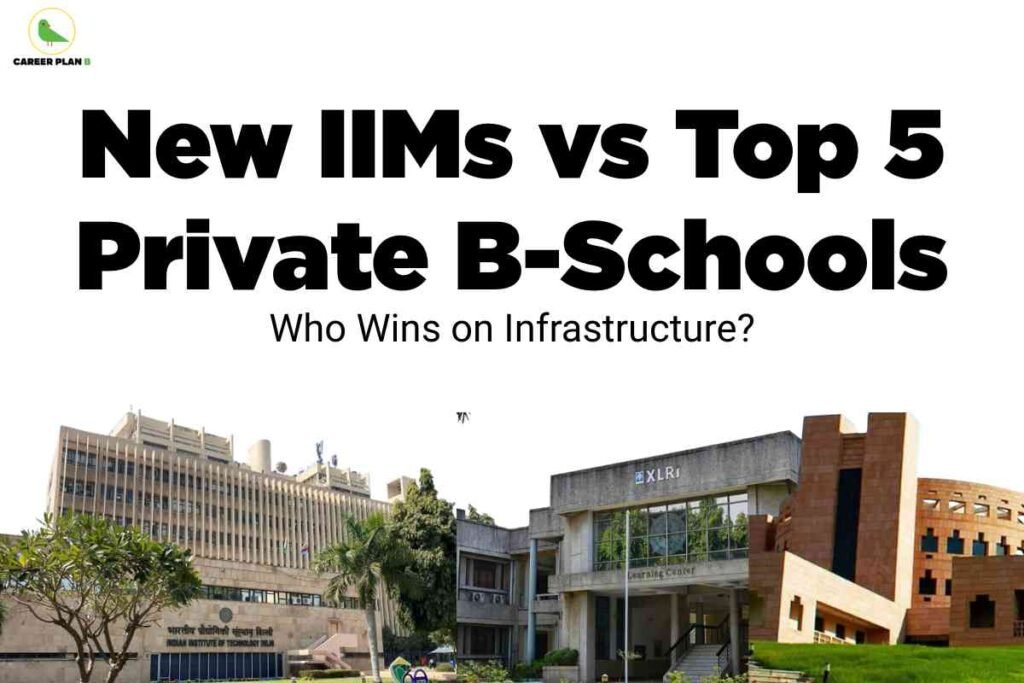
Introduction
When an MBA aspirant thinks about business schools in India, the first image that often comes to mind is the hallowed three letters—IIM. For decades, the older IIMs (Ahmedabad, Bangalore, Calcutta, Lucknow) defined management education in India. But in the last 15 years, the government has extended the IIM network by setting up new (or baby) IIMs, including IIM Nagpur, IIM Visakhapatnam, IIM Amritsar, and IIM Bodh Gaya.
Yet, here’s the real dilemma: while the new IIMs bring prestige to the IIM brand, they are still in the process of establishing their infrastructure. On the other hand, top private B-schools—such as NMIMS Mumbai, SIBM Pune, SPJIMR Mumbai, XIMB Bhubaneswar, and Great Lakes Chennai—boast decades-old campuses with fully developed facilities, offering MBA students a self-contained world of growth, learning, and lifestyle.
So, if you’re choosing between the IIM name and established private giants, one crucial factor is: infrastructure. From classrooms and campus tech to hostels and student experiences, how do the two compare? Let’s dive deep.
The Rise of Baby IIMs
The term “baby IIMs” (or new IIMs) refers to institutes established between 2010 and 2015 to broaden access to management education at the IIM level. Some of the prominent names include:
- IIM Nagpur
- IIM Visakhapatnam
- IIM Amritsar
- IIM Bodh Gaya
- IIM Sirmaur
- IIM Sambalpur
In their initial years, many of these IIMs functioned from temporary campuses, usually borrowed classrooms within state universities. Over time, most have moved or are moving into sprawling permanent campuses.
For example:
- IIM Nagpur now operates from a 132-acre permanent campus with hostels, auditoriums, and tech-enabled classrooms.
- IIM Visakhapatnam has a 230-acre campus coming up, with modern classrooms, labs, and student housing facilities.
- IIM Sambalpur and Bodh Gaya are making steady progress in permanent housing, faculty blocks, and digital classrooms.
The progress is clear, but the reality is that many new IIMs are still completing large parts of their infrastructure roadmap. Aspirants need to assess whether the “brand” compensates for sometimes-limited facilities in the short term.
Infrastructure Strength of Top Private B-Schools
Now let’s turn to the top 5 private B-schools often compared with new IIMs:
- NMIMS Mumbai: A city-campus advantage with strong residential and digital resources.
- SIBM Pune: Set on a hilltop Lavale campus, with green surroundings, sports arenas, and modern hostels.
- SPJIMR Mumbai: Known for academic simulation labs, well-planned classrooms, and a Mumbai location advantage.
- XIMB Bhubaneswar: A 20-acre landscaped campus with auditoriums, libraries, and robust student clubs.
- Great Lakes Chennai: Built as a modern residential B-school focused on analytics and technology learning.
Being much older and funded privately, these B-schools invested heavily in self-contained ecosystems. Hostels, food courts, sports grounds, Wi-Fi-enabled academic blocks, cultural auditoriums, and research libraries are well developed and deeply integrated into student life.
Unlike baby IIMs, which are still transitioning from makeshift beginnings, these private B-schools offer plug-and-play infrastructure that MBA students can experience from day one.
Comparative Aspects: Baby IIMs vs Top Private B-Schools
To make the analysis sharper, let’s break down infrastructure into specific student-relevant categories.
Classrooms & Learning Technology
In the modern MBA classroom, infrastructure is more than seating capacities—it requires smart boards, projectors, acoustics, case-study tech setups, and student discussion rooms.
- Baby IIMs: Many have shifted to new smart classrooms, but scale is still limited. IIM Nagpur and Bodh Gaya have invested in state-of-the-art technology, yet the variety and capacity lag behind private peers.
- Top Private B-Schools: Places like SPJIMR have advanced simulation labs, role-play rooms, and e-learning centers. Great Lakes is equipped with advanced tech for analytics teaching.
Verdict: Private B-schools currently lead in classroom innovation.
Libraries & Digital Resources
MBA relies heavily on access to research journals, databases, and real-time market subscriptions.
- Baby IIMs: While they provide access to standard databases (JSTOR, EBSCO, ProQuest), the collections are still expanding. Faculty research culture is growing but not yet comparable to older IIM or private peers.
- Private B-Schools: SPJIMR, XIMB, and NMIMS have well-stocked physical libraries and robust subscriptions to Bloomberg terminals, CRISIL databases, and international case archives.
Verdict: Private B-schools win in depth and breadth of resources.
Hostel & Residential Facilities
MBA life isn’t just about academics—it’s about the community you live in for two years.
- Baby IIMs: Most provide basic residential facilities. Hostels are modern but may be limited in capacity and amenities since campuses are still under expansion. For example, in some IIMs shared accommodations remain common.
- Top Private B-Schools: SIBM Pune’s Lavale campus offers well-furnished residential blocks, gyms, amphitheater-like social spaces, and lush outdoors. Great Lakes Chennai comes with a residential model focusing on community living.
Verdict: Private schools again dominate, although newer IIMs like Nagpur are catching up.
Sports, Cafeteria & Student Activities
Your MBA experience is shaped as much outside classrooms as inside.
- Baby IIMs: Facilities for sports, recreation, and fests exist but often on smaller scales due to phase-wise campus completion.
- Private B-Schools: Established sporting arenas—cricket, basketball, gyms, auditoriums for fests—and vibrant clubs. Example: XIMB is known for its celebrated cultural fests and student-organized national events.
Verdict: Private players have the first-mover advantage.
Comparative Table
| Factor | Baby IIMs | Top 5 Private B-Schools |
| Classrooms | Modern smart boards, still fewer in number | Simulation labs, advanced digital learning |
| Libraries | Good access to core databases, growing collections | Established with Bloomberg, CRISIL, foreign journals |
| Hostels | New, functional but evolving capacity | Spacious, well-integrated residential ecosystems |
| Sports/Cultural | Available but limited due to new campuses | Large grounds, gyms, auditoriums, rich fest culture |
| Campus Ecosystem | Developing phase, many under construction | Mature, fully operational environments |
How Career Plan B Helps
Choosing between a baby IIM and a top private B-school isn’t just about infrastructure—it’s about balancing brand reputation, placements, lifestyle, and personal goals. This is where Career Plan B steps in.
Our services can make the choice clearer for you:
- Personalized Career Counselling: Understand whether you should prioritize the IIM name or complete ecosystem.
- Psycheintel and Career Mapping: Scientifically assess what matters more for your personality—structured environments or vibrant peer experiences.
- Admission Guidance: Craft strong profiles and applications to both private B-schools and new IIMs.
- Career Roadmapping: See beyond the two-year campus life and evaluate which choice aligns with your career aspirations.
With structured mentorship, Career Plan B helps aspirants like you make confident and informed MBA decisions.
Frequently Asked Questions
- Are baby IIMs at par with private B-schools in infrastructure?
Not yet. While new IIMs are rapidly building permanent campuses, private B-schools often enjoy more developed infrastructure today. - Which matters more: brand or facilities?
Brand helps in long-term recognition and alumni networks, while facilities impact your immediate MBA experience. It depends on personal priorities. - Do new IIMs have permanent campuses now?
Most are in the process of shifting. For example, IIM Nagpur and IIM Visakhapatnam have seen big progress, while some are still developing core campus parts. - Can better infrastructure influence placements?
Indirectly. Facilities foster a stronger peer culture, research, and company engagement, which can boost placements. - Should hostel and lifestyle influence MBA selection?
Absolutely. You’ll spend two crucial years of your life there. A comfortable residential and vibrant campus can deeply affect learning outcomes.
Conclusion
The comparison between baby IIMs vs top private B-schools is not a straightforward battle. New IIMs are making significant strides in infrastructure but are still evolving. In contrast, the top private schools boast mature, world-class facilities that provide a more immersive student experience right away.
Ultimately, your choice depends on whether you prioritize the prestige of the IIM brand for long-term impact or the holistic, ready-to-experience environment of private B-schools.
And if you’re unsure, remember—Career Plan B can help you chart the path that aligns best with your dreams.