Martha Divakar · March 11, 2026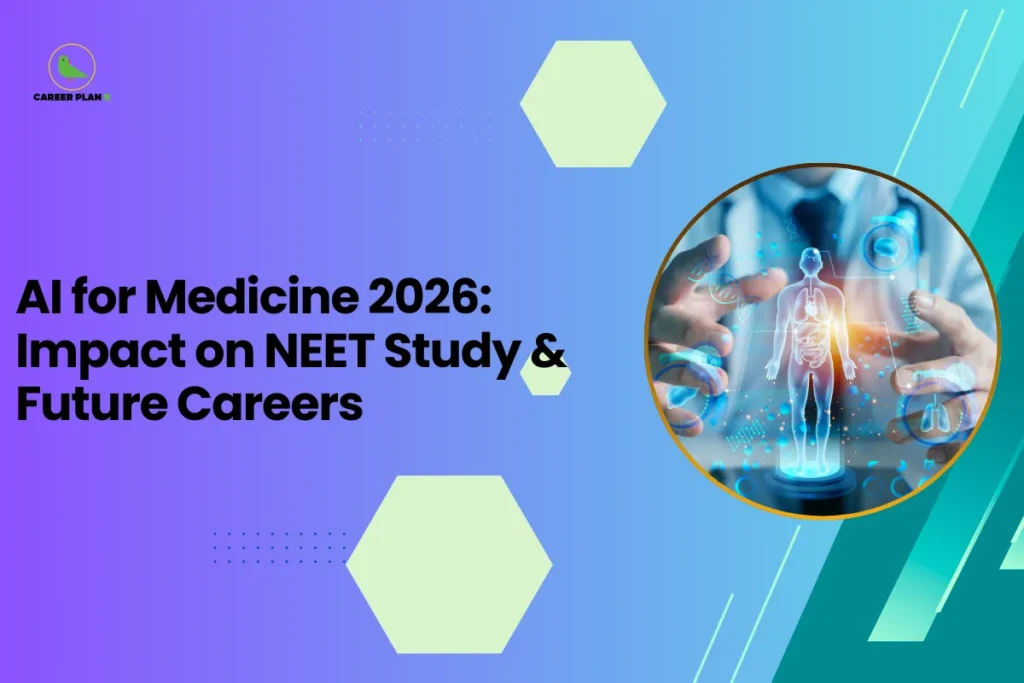
Introduction
Imagine sitting for your NEET exam preparation and having an intelligent tutor that instantly spots your weak topics in Biology, creates custom practice questions, and predicts your score trends. Or picture a doctor using AI to spot a rare disease in seconds from an X-ray. This isn’t the distant future; it’s happening right now in 2026.
Artificial intelligence in medicine is no longer experimental. In India, the healthcare sector is embracing AI rapidly, with tools boosting diagnostics, reducing doctor burnout, and bridging rural-urban gaps. For NEET 2026 aspirants, this shift means smarter study methods and a changing medical career landscape.
In this post, we’ll explore AI’s growing role in medicine, its impact on medical education and careers, how it’s revolutionizing NEET coaching, and practical steps to prepare. Whether you’re a Class 12 student dreaming of MBBS or a parent guiding one, understanding AI in medicine 2026 will help you stay ahead.
What Is the Role of AI in Medicine in 2026?
AI has moved from a buzzword to a core part of healthcare. In 2026, it’s deeply integrated across diagnostics, treatment, and operations.
- Advanced Diagnostics & Imaging — AI analyzes scans like CT, MRI, and X-rays with high accuracy, often spotting issues faster than humans alone. Tools detect heart conditions early or flag polyps during procedures, cutting delays and errors.
- Drug Discovery Acceleration — Generative AI screens massive datasets to find promising compounds, predict interactions, and reduce development time and costs. Phase III trials in 2026 are testing AI-designed drugs at scale.
- Personalized Care & Administrative Relief — AI agents handle scheduling, risk prediction, scribing notes, and follow-ups, freeing doctors for patient focus. In India, this helps address high patient loads and rural access issues.
India’s outlook is strong: With initiatives like government-backed programs and a growing startup scene, AI bridges gaps in affordable care. Experts predict clinical-grade AI will support diagnostics, personalized planning, and preventive strategies widely.
How Is AI Transforming Medical Education and Careers?
Medical education is evolving fast. AI personalizes learning, simulates real scenarios, and builds essential skills.
Students now use AI for virtual anatomy labs, adaptive practice, and clinical simulations. In India, the National Board of Examinations in Medical Sciences (NBEMS) launched a free online course on AI in Medical Education in early 2026. It targets thousands of doctors and faculty, covering AI applications in diagnostics, decision-making, research, and teaching. Over 40,000 doctors registered quickly, showing huge demand for AI literacy.
For future doctors, AI won’t replace you; it augments. You’ll need skills to use AI ethically, interpret outputs, and combine it with human judgment. New roles emerge: AI specialists in hospitals, experts in ethical AI use, and leaders in precision medicine.
Medical careers with AI mean better outcomes, like faster diagnoses in remote areas or tailored treatments. Specialties heavy on imaging or data (radiology, pathology) see big changes, while empathy-driven fields grow with AI handling routine tasks.
The Future of NEET Preparation: AI-Powered Coaching in 2026
NEET coaching is shifting from one-size-fits-all classes to intelligent, adaptive systems. For NEET 2026 aspirants, AI tools make preparation more efficient and targeted.
- Personalized study plans analyze your performance and adjust focus; spend more time on weak areas like Organic Chemistry or Human Physiology.
- Adaptive mock tests increase difficulty based on answers, with real-time feedback and explanations.
- 24/7 AI tutors generate unlimited practice questions, simplify tough concepts, and track progress.
Platforms offer biometric insights (in advanced cases) to manage stress and optimize schedules. Traditional coaching integrates these tools for hybrid models; better results with less burnout.
Tips for NEET 2026 aspirants:
- Try free/paid AI apps for daily practice and mock analysis.
- Use data-driven revision—focus on patterns in mistakes.
- Combine with human guidance for motivation and doubt-solving.
This approach helps crack competitive exams smarter.
How Career Plan B Helps
If you’re a NEET aspirant exploring AI-influenced medical paths or considering backups,
Career Plan B provides
- Personalized Career Counselling and
- Psycheintel and Career Assessment Tests
- Admission and Academic Profile Guidance
- Custom Career Roadmapping
creates clear steps toward a future-proof medical career.
Have any doubts?
📞 Contact our expert counsellor today and get all your questions answered!
FAQ
- Will AI replace doctors by 2026?
No. AI augments doctors, handling data-heavy tasks while human empathy, judgment, and ethics remain essential. Experts stress AI as a tool, not a replacement.
- How can NEET aspirants use AI for preparation?
Use AI for adaptive mocks, personalized plans, extra questions, and weak-area focus. Many platforms provide real-time feedback to improve efficiency.
- Is AI part of the MBBS curriculum now?
It’s emerging. NBEMS’s 2026 AI course targets postgrads and faculty, but undergrads benefit from tools and simulations. Many colleges introduce AI literacy.
- What skills should future doctors learn?
AI basics, data interpretation, ethical use, and critical thinking. Combine tech with clinical skills for hybrid roles in diagnostics or research.
- How is India adopting AI in healthcare?
Rapidly; through government programs, summits, and devices for faster, affordable care in rural areas. AI bridges access gaps and boosts outcomes.
Conclusion
In 2026, AI in medicine enhances diagnostics, speeds drug discovery, personalizes care, and transforms education. For NEET aspirants, AI-powered tools make preparation smarter and more effective, while future medical careers demand AI skills alongside core medical knowledge.
Embrace AI early; it won’t replace great doctors, but doctors who use AI will outpace others.