Martha Divakar · March 7, 2026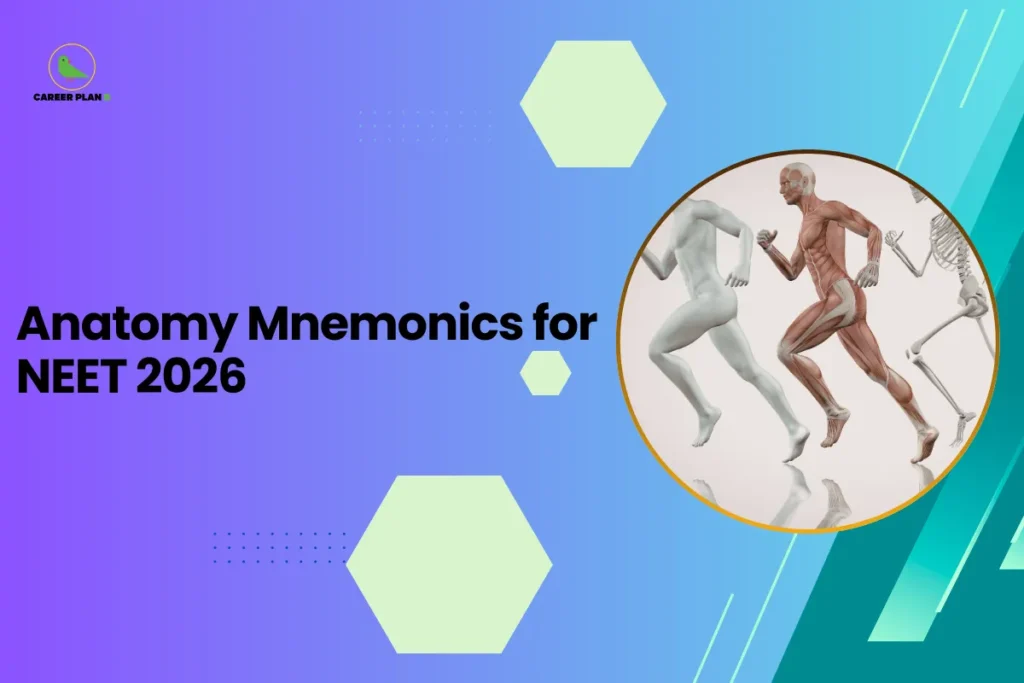
Introduction
Anatomy can feel overwhelming with its endless names and details, especially when you’re racing against time for NEET UG. But here’s the good news: the right mnemonics turn confusion into quick recall. Many toppers swear by them because they make tricky topics fun and memorable.
Every year, anatomy contributes around 15-20 questions in NEET (often 20+ in recent patterns from human physiology and structural organization sections). Forgetting one small detail can cost marks. These anatomy mnemonics for NEET are timeless classics that will still work perfectly in 2026; no major syllabus shifts have outdated them. They’re funny, short, and targeted at high-yield areas like head & neck, upper limb, and lower limb.
Ready to make anatomy your strength? Let’s dive into the best ones.
Why Mnemonics Are a Game-Changer for NEET Anatomy in 2026
Mnemonics help you retain facts faster than rote learning. They use humor, rhythm, or stories to create mental hooks. For NEET, where MCQs test quick recall, these save precious seconds in the exam hall.
Pair each mnemonic with a quick diagram sketch or active recall (test yourself after 10 minutes). This combo boosts long-term memory.
Have you ever mixed up the order of carpal bones or forgotten a cranial nerve? These will fix that.
Top Cranial Nerves Mnemonic (Head & Neck Must-Know)
Cranial nerves appear frequently in NEET questions: names, order, and functions.
Classic mnemonic for names (I to XII):
“Oh Oh Oh To Touch And Feel Very Good Velvet AH!”
(or the funnier modern version: “Oh Oh Oh To Touch And Feel Very Green Vegetables AH Heaven”)
- O – Olfactory (I)
- O – Optic (II)
- O – Oculomotor (III)
- T – Trochlear (IV)
- T – Trigeminal (V)
- A – Abducens (VI)
- F – Facial (VII)
- V – Vestibulocochlear (VIII)
- G – Glossopharyngeal (IX)
- V – Vagus (X)
- A – Accessory (XI)
- H – Hypoglossal (XII)
Why it works: The repeating “Oh” matches the first three sensory nerves. Use it to nail order questions instantly.
Brachial Plexus Mnemonic – Never Forget Roots to Branches
The brachial plexus is a NEET favorite: questions on structure, branches, or injuries pop up often.
Mnemonic for organization: “Randy Travis Drinks Cold Beer”
- R – Roots (C5-T1)
- T – Trunks (Upper, Middle, Lower)
- D – Divisions (Anterior & Posterior – each trunk splits)
- C – Cords (Lateral, Posterior, Medial)
- B – Branches (main terminal nerves)
Bonus for posterior cord branches: “ULTRA” (Upper subscapular, Lower subscapular, Thoracodorsal, Radial, Axillary)
Rotator Cuff Muscles – Easy Shoulder Recall
Rotator cuff injuries or functions are tested regularly.
Mnemonic: “SITS”
- S – Supraspinatus (abduction initiation)
- I – Infraspinatus (external rotation)
- T – Teres minor (external rotation)
- S – Subscapularis (internal rotation)
Think of the shoulder “sitting” stable thanks to these four. Super simple for MCQs on actions.
Carpal Bones Mnemonic (Upper Limb Essential)
Carpal bones order trips up many students—proximal row then distal, lateral to medial.
Popular mnemonic: “Some Lovers Try Positions That They Can’t Handle”
Proximal row:
- Scaphoid
- Lunate
- Triquetral
- Pisiform
Distal row:
- Trapezium
- Trapezoid
- Capitate
- Hamate
Alternative: “Please Take Little Susy To The Coffee House” (same order).
Picture a dramatic love story—makes it unforgettable.
Tarsal Bones Mnemonic (Lower Limb High-Yield)
Tarsal bones (foot) are less frequent but still appear.
Mnemonic: “Tiger Cubs Need MILC”
- Talus
- Calcaneus
- Navicular
- Medial cuneiform
- Intermediate cuneiform
- Lateral cuneiform
- Cuboid
(Proximal to distal, roughly medial to lateral for cuneiforms.)
Quick and animal-themed—easy to recall during lower limb questions.
Bonus High-Yield Ones for Quick Wins
- Scalp layers: “SCALP” (Skin, Connective tissue, Aponeurosis, Loose connective tissue, Pericranium)
- Dermatomes quick hits: T4 at nipple, T10 at umbilicus (common trap questions)
These extras save time in last-minute revision.
How Career Plan B Helps
Preparing for NEET anatomy is intense, and planning your medical journey adds pressure. Career Plan B provides personalized career counselling, Psycheintel and career assessment tests, admission and academic profile guidance, plus career roadmapping. It helps you stay confident with strong backups while focusing on your dream MBBS seat.
Have any doubts?
📞 Contact our expert counsellor today and get all your questions answered!
FAQ – Anatomy Mnemonics for NEET
- Are these mnemonics still valid for NEET 2026?
Yes! The core anatomy hasn’t changed in recent years. These classics remain high-yield and match the latest patterns.
- How many mnemonics should I memorize?
Start with 5–7 high-yield ones (like the ones above). Focus on brachial plexus, cranial nerves, and rotator cuff first—they appear most.
- What’s the best way to practice them?
Write them daily, teach a friend, or use flashcards. Test with past NEET questions to see instant improvement.
- Do these help in other exams too?
Absolutely; many work for NEET PG, FMGE, or MBBS profs.
- Any quick revision tip?
Revise mnemonics with diagrams 2–3 times a week. Apps like Anki can space them out perfectly.
Conclusion
These anatomy mnemonics for NEET simplify the toughest topics and turn weak areas into scoring ones. Start with cranial nerves and brachial plexus today; test yourself and watch your confidence grow.
Pick 2–3 right now and practice them. You’ve got this; consistent small wins lead to big scores in 2026.