Martha Divakar · November 1, 2025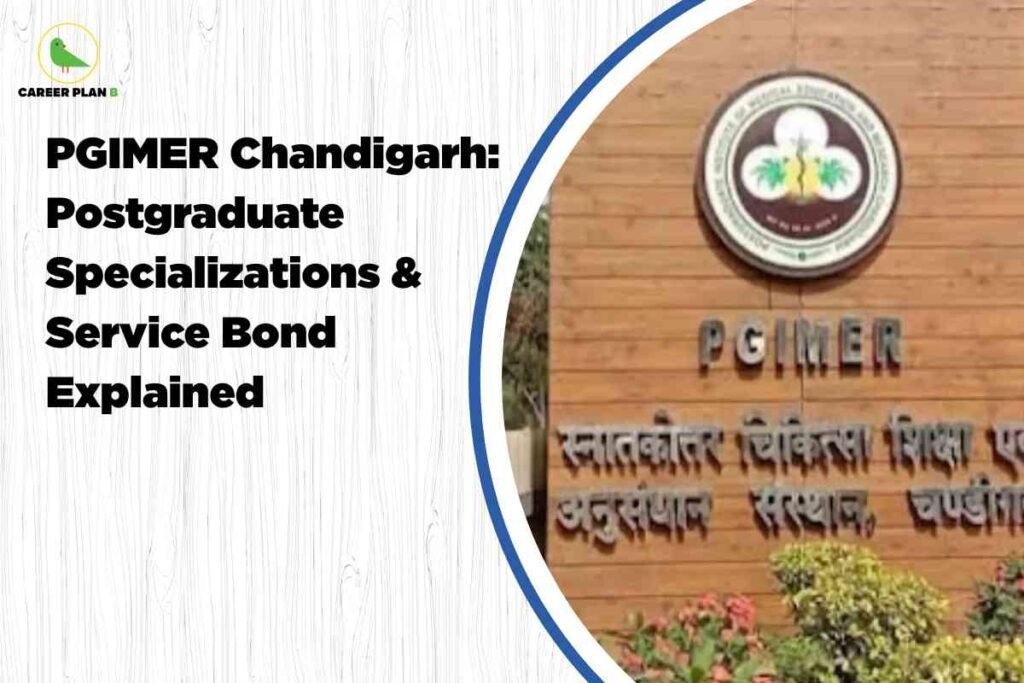
Introduction
Making the right choice for postgraduate medical studies isn’t just about securing a seat—it’s about finding a program that truly launches your career. PGIMER Chandigarh is consistently ranked among India’s finest medical institutions, renowned for clinical excellence, research facilities, and a rich array of postgraduate specializations. But what about service bonds and obligations after graduation—how do they affect life and career choices? Whether aiming for MD, MS, super-specialty, or paramedical programs, this guide covers everything you need to know, including service bond rules, fees, and practical advice for PGIMER hopefuls.
PGIMER Chandigarh at a Glance
- Institute of National Importance and Centre of Excellence
- Ranked #2 in Medicine by NIRF 2025 (for the sixth year in a row)
- Leading roles in WHO, ICMR, US NIH, and European medical research collaborations
PGIMER’s legacy is built upon decades of patient care, innovation, and producing medical leaders across India and abroad.
Postgraduate Specializations at PGIMER
MD & MS Programs: The Backbones of Clinical Careers
PGIMER offers one of the widest arrays of MD and MS branches in the country.
Here’s a selection of core specializations:
| Degree | Major Specializations | Duration |
|---|---|---|
| MD | Medicine, Pediatrics, Microbiology, Dermatology, Nuclear Medicine, Psychiatry, Obstetrics & Gynaecology, Radiodiagnosis, Anesthesia, Pathology, Pharmacology, Transfusion Medicine, Forensic Medicine, Hospital Administration, Community Medicine |
3 years |
| MS | General Surgery, Orthopedics, Otolaryngology (ENT), Ophthalmology | 3 years |
Highlights:
- PGIMER admissions rely on INI CET and institute-run entrance exams.
- Faculty combine patient therapy with research, and nearly every department participates in global trials or innovation.
- Students often rotate through renowned departments and research units, gaining exposure far beyond textbook learning.
Super-Specialty: DM, MCh, MDS, Ph.D., MPH
Beyond core MD/MS, PGIMER is a pioneer in super-specialties:
| Program | Specializations | Duration |
|---|---|---|
| DM/MCh | Cardiology, Neurology, Nephrology, Neurosurgery, Pediatric Hematology-Oncology, Gastroenterology, Clinical Pharmacology, Interventional Radiology, Pulmonary/Critical Care |
3–6 years |
| MDS | Prosthodontics, Periodontics, Oral Surgery | 3 years |
| Ph.D. | Biomed Sciences, Public Health, Medical Genetics | 3–5 years |
| MPH/MHA | Public Health, Hospital Administration | 2 years |
| MSc/Paramedical | Med Tech, Biochemistry, Pharmacology, Nursing | 2 years |
Emerging Trends:
PGIMER departments regularly adapt their curriculum to match NEP recommendations and next-gen research needs.
Service Bond Details: Work Obligations After PG
Why Do Service Bonds Exist?
Public medical institutes like PGIMER often require graduates to fulfill a period of government service (bond) to ensure quality healthcare reaches every corner of India. Understanding these rules is critical for career planning.
PGIMER Service Bond Structure
- Bond Tenure: Typically, 3 years of government service post-PG
- Bond Amount: Around INR 10–25 lakhs (varies by year/policy)
- Applicability: Most PG programs (MD/MS), some exceptions for certain diplomas or fellowships
- Enforcement: Non-compliance may result in penalty payment and disqualification from future government institutes (temporarily)
- Location: Usually in public hospitals or rural postings under state/central govt
Rhetorical Question: Does fulfilling a service bond align with your career goals—or does it feel like a limitation?
Real-World Example
Many PGIMER alumni cite service bonds as an opportunity to hone clinical skills, build public health experience, and even develop leadership traits in challenging environments. One pediatrician shared: “My rural posting showed me the realities of resource constraints and real patient impact—the experience shaped my clinical approach for life.”
Stipend, and Financial Advice
- Stipend: Standard government medical stipend (changes yearly; averaged at INR 60,000–80,000/month in recent sessions)
- Additional Costs: Hostel fees, research/project expenses, occasional travel for conferences
How to Choose Your PGIMER Specialty
What Makes a Specialization Right for You?
Consider:
- Personal interest and aptitude
- Career prospects and demand (General Medicine, Radiology, Pediatrics remain most competitive)
- Availability of research and super-speciality opportunities
- Willingness to commit to a service bond period
Comparison Table: Sample PGIMER PG Seats & Branches
| Specialization | Seat Intake | Bond Applicable? |
|---|---|---|
| MD General Medicine | ~30 | Yes |
| MD Pediatrics | ~20 | Yes |
| MS General Surgery | ~25 | Yes |
| DM Cardiology | ~8–10 | Yes |
| MCh Neurosurgery | ~7–9 | Yes |
| MPH/Public Health | ~10 | Variable |
Numbers subject to change; always check with official PGIMER notifications.
Frequently Asked Questions
1. Does every PGIMER postgraduate program have a service bond?
Most clinical PG programs require service bonds. Exceptions include some paramedical and research-oriented courses; always check the official notification for updated lists.
2. Can service bonds be bought out, and is the penalty always enforced?
Bond penalties must be paid if not served, and postponement is rare. Non-compliance may affect future government job eligibility.
3. What are the most sought-after PGIMER specializations?
General Medicine, Pediatrics, Radiology, Surgery, and Cardiology lead the list for both competition and career scope.
4. How competitive is the PGIMER entrance exam (INI CET)?
Extremely competitive—PGIMER ranks among India’s best, with applicants from across the country targeting a limited number of seats. Strong basics and previous NEET PG success give aspirants an edge.
5. What is the stipend and scholarship situation for PGIMER PG students?
Government-standard stipend is offered, plus merit or research scholarships for select students. Rural postings under bond also carry salary, though slightly less than academic residency roles.
6. Can Career Plan B help with PGIMER counseling and service bond planning?
Absolutely—Career Plan B offers impartial, expert guidance so families and candidates can make well-informed decisions based on market trends and personal aspirations.
Conclusion
PGIMER Chandigarh offers not only breadth in postgraduate medical education but also a clear path to serving society and accelerating professional growth. Understanding its diverse specializations and service bond rules is key for aspirants to plan both academic and future work life. Ready to take the leap into advanced medicine with guidance on admission and career planning? Connect with Career Plan B—our not-for-profit, unbiased support helps you navigate every decision toward your best future.