Martha Divakar · September 21, 2025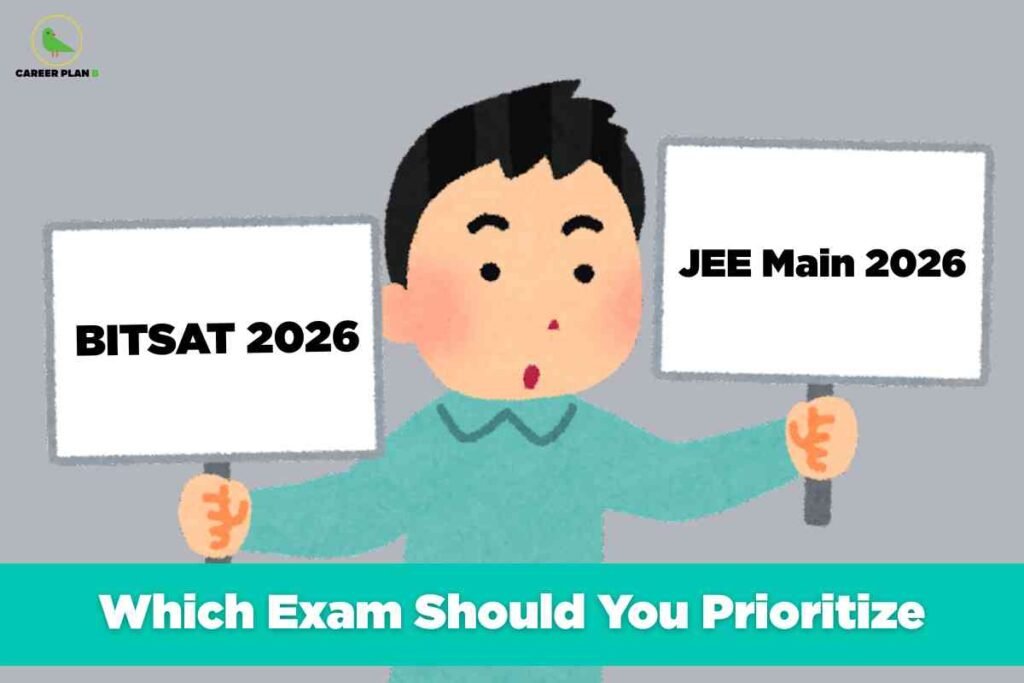
Introduction
In the competitive world of Indian engineering entrance exams, BITSAT vs JEE Main are two of the biggest names. For 2026 aspirants, choosing between IITs/NITs via JEE or BITS through BITSAT can shape their entire career path.
This guide simplifies the decision-making process. In the competitive world of Indian engineering entrance exams, BITSAT vs JEE Main are two of the biggest names, and we break down their structure, differences, and strategies to help you prepare smarter and choose the path that best fits your goals.
Understanding BITSAT and JEE Main
JEE Main 2026: The Test of Depth
JEE Main is a national-level test for admission to NITs, IIITs, and other premier institutions. It is also the qualifying exam for JEE Advanced, the gateway to the IITs.
- Subjects: Physics, Chemistry, and Mathematics.
- Exam Pattern: 75 questions to be attempted in 3 hours.
- Focus: It emphasizes a deep, thorough understanding of concepts. The questions are often multi-conceptual and require strong analytical skills.
BITSAT 2026: The Test of Speed and Breadth
BITSAT is the online entrance exam for admission to BITS campuses in Pilani, Goa, and Hyderabad.
- Subjects: Physics, Chemistry, Mathematics, plus English Proficiency and Logical Reasoning.
- Exam Pattern: 130 questions to be attempted in 3 hours.
- Focus: It is a high-speed exam that tests your ability to apply concepts quickly and accurately. The inclusion of English and Logical Reasoning requires a broader skill set.
Detailed Analysis and Key Differences
1. The Syllabus Overlap
The core Physics, Chemistry, and Mathematics syllabus for BITSAT is largely a subset of the JEE Main syllabus. This is a crucial point: preparing thoroughly for JEE Main automatically covers about 80-90% of the BITSAT PCM syllabus. However, BITSAT requires additional preparation for its English and Logical Reasoning sections.
2. The Speed vs. Depth Challenge
This is the most significant difference.
- JEE Main: You get approximately 2.4 minutes per question. This allows time for in-depth thinking and complex calculations.
- BITSAT: You get only 1.38 minutes per question. This intense time pressure means you must have concepts and formulas at your fingertips. There is no time to derive or ponder.
3. BITSAT’s Unique Bonus Questions
BITSAT has a game-changing feature that JEE Main lacks. If you finish all 130 questions before the 3-hour mark, you can attempt 12 extra “bonus questions” (4 from each PCM subject). These questions are often slightly more challenging, but answering them correctly can dramatically boost your score. This feature heavily rewards students who are both fast and accurate.
Which Exam Should You Prioritize?
- Prioritize JEE Main if: Your strength lies in in-depth problem-solving, you have a very strong command of core PCM concepts, and your ultimate dream is to get into an IIT or a top NIT. Your preparation will naturally cover most of BITSAT.
- Prioritize BITSAT if: You are exceptionally fast at solving problems, have a good command of English and logical reasoning, and are specifically targeting the innovative curriculum and vibrant campus life at BITS.
For most students, the optimal strategy is to prepare for JEE Main as the primary goal, while simultaneously practicing speed tests and the extra sections for BITSAT.
How Career Plan B Can Transform Your Journey
Navigating this path requires a strategy tailored to you. Career Plan B helps you by:
- Personalized Career Counselling: Our psychometric assessments can determine if your skills align better with a speed-based exam (BITSAT) or a depth-based exam (JEE Main).
- Customized Roadmapping: We help you create an integrated study plan that covers the overlapping syllabus while dedicating specific time for BITSAT’s unique sections.
- Strategic Mock Test Analysis: We provide tools to analyze your performance, helping you master the distinct time management required for each exam.
Book Free session with career plan b today
Frequently Asked Questions
1.What are the fundamental differences between BITSAT and JEE Main?
JEE Main (75 questions in 3 hours) focuses on the depth of your PCM knowledge. BITSAT (130 questions in 3 hours) is a speed-based test that also includes mandatory sections on English and Logical Reasoning.
2.Is BITSAT easier than JEE Main?
No, their difficulty is different. JEE Main’s questions are conceptually deeper and more complex. BITSAT’s challenge comes from the extreme time pressure and the need to be proficient in five subjects instead of three.
3.What are the BITSAT bonus questions?
If you complete all 130 questions in BITSAT before the 3-hour time limit, you unlock an optional section of 12 extra, challenging questions. Answering these can significantly improve your final score.
4.Can I prepare for both exams simultaneously?
Yes, this is the recommended strategy. Prepare for JEE Main as your foundation, as its syllabus covers most of BITSAT’s PCM section. Dedicate a few hours each week specifically to practicing speed tests and solving English/Logical Reasoning questions for BITSAT.
5.Which exam has more competition?
JEE Main has a much larger number of applicants (over 1.2 million), making the overall competition ratio higher. However, BITSAT is also highly competitive for its limited number of seats, attracting a very talented pool of candidates.
Conclusion
Choosing between BITSAT 2026 and JEE Main 2026 requires a careful look at your personal strengths and academic goals. While JEE Main tests your conceptual depth, BITSAT is a race against time that rewards speed, accuracy, and broader aptitude.
For most aspirants, a robust preparation for JEE Main provides a strong foundation for BITSAT. By layering on speed-based practice and dedicated time for English and Logical Reasoning, you can effectively prepare for both.
Embark on your preparation journey with confidence, and remember, the right support can make all the difference. Reach out to Career Plan B today and take the first step towards a successful engineering career.