Geetansh · March 28, 2026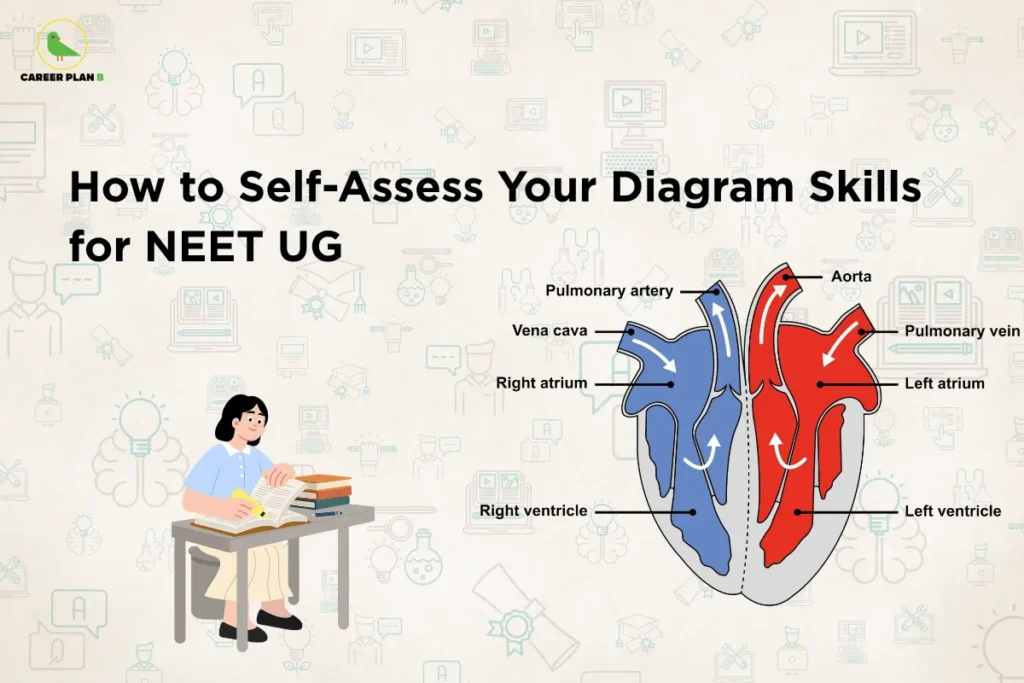
Introduction
Picture this: You’ve spent weeks studying biology. You know the theory of the nephron by heart. But when the NEET UG exam paper lands on your desk, the diagram question leaves you staring blankly. Sound familiar?
This is one of the most common and costly mistakes NEET aspirants make. They focus heavily on theory but underestimate the power of diagram skills for NEET UG. Diagrams aren’t just drawings. They are a direct test of how deeply you understand a concept.
So how do you know if your diagram preparation is actually on track? The answer lies in self-assessment. In this blog, we’ll walk you through simple, practical tips to evaluate where you stand and how to improve before exam day.
Why Diagram Skills Matter More Than You Think in NEET UG
Every year, NEET UG includes multiple questions that either directly ask you to identify parts of a diagram or test concepts best understood through visuals. Topics like the structure of the human heart, the nephron, the eye, mitosis and meiosis, and the process of photosynthesis are high-weightage areas where diagrams play a central role.
Here are some key biology diagrams for NEET that you simply cannot afford to skip:
- Human heart and its chambers
- Nephron structure
- Human eye and ear
- Stages of mitosis and meiosis
- T.S. of dicot root and stem
- Neuron structure
- Reproductive systems
If you can’t draw and label these accurately under timed conditions, there’s a gap in your NEET biology preparation — and self-assessment is the first step to closing it.
Confused about your next steps? Get a personalized roadmap tailored to your career goals.
What Does Self-Assessment of Diagram Skills Actually Mean?
Many students think they know their diagrams because they’ve looked at them in a textbook. But looking is not the same as knowing.
Self-assessment means actively testing yourself — drawing diagrams without reference, checking for accuracy, identifying missing labels, and noting where your understanding breaks down. It’s the difference between passive revision and active learning. And in NEET UG preparation, that difference can mean the gap between a good score and a great one.
6 Practical Tips to Self-Assess Your Diagram Skills for NEET UG
1. Draw from Memory — Then Compare
Close your textbook and draw the diagram from scratch. Once done, open the book and compare. Mark every missing label, incorrect arrow, or wrong proportion. This simple exercise reveals exactly where your understanding is weak — far better than re-reading ever could.
2. Use a Diagram Checklist
Create a checklist of all important NEET diagrams topic-wise. After each study session, tick off diagrams you can draw confidently and flag ones that need more NEET diagram practice. This gives you a clear visual map of your progress and prevents you from skipping diagrams unintentionally.
3. Time Yourself While Drawing
In the actual exam, you don’t have unlimited time. Practice drawing key diagrams within 2–3 minutes. If you’re taking 7–8 minutes, that’s a red flag. Timed self-assessment builds both speed and muscle memory — two things that matter enormously on exam day.
4. Attempt Past Year NEET Diagram Questions
One of the most effective ways to assess yourself is by solving previous years’ NEET UG papers. Look specifically for diagram-based questions and attempt them without help. This tells you whether your preparation aligns with actual exam standards and helps you understand how to study diagrams for NEET more strategically.
5. Record and Review Your Mistakes
Keep a dedicated “mistake notebook” for diagrams. Every time you get a label wrong or forget a part, write it down. Review this notebook weekly. Patterns will emerge — maybe you always forget the Bowman’s capsule or mix up mitosis stages. Targeted revision based on real mistakes is far more effective than random restudying.
6. Seek Feedback from a Mentor or Peer
Self-assessment has limits. Sometimes you need an outside perspective. Share your drawn diagrams with a teacher, mentor, or study partner and ask for honest feedback. A fresh pair of eyes often catches errors you’ve been overlooking for weeks. This is especially useful as part of a structured medical entrance exam tips strategy.
How Career Plan B Helps
Preparing for NEET UG isn’t just about studying harder; it’s about studying smarter.
Career Plan B provides
- Personalized career counselling
- Psycheintel and career assessment tests
- Admission and academic profile guidance
- Detailed career roadmapping
you get a structured plan to approach your NEET preparation with clarity and confidence.
For Latest Information
FAQs on Diagram Skills for NEET UG
Q1. How many diagrams should I prepare for NEET UG?
Focus on approximately 30–40 high-weightage diagrams from Class 11 and 12 NCERT biology. Prioritize chapters like Human Physiology, Reproduction, and Cell Division.
Q2. Are diagrams directly asked in NEET UG?
Yes. While NEET is an MCQ-based exam, many questions are diagram-based — showing an image and asking you to identify a part or process. Strong diagram skills directly improve your score.
Q3. How often should I practice diagrams during NEET preparation?
Ideally, include diagram practice at least 3–4 times a week. In the final two months before the exam, increase this to daily revision of key diagrams.
Q4. What is the best way to remember complex diagrams for NEET?
Break the diagram into sections and learn each part step by step. Use colour coding, draw repeatedly, and always practise labelling from memory rather than copying.
Conclusion
Diagram skills for NEET UG are not a bonus — they’re a necessity. The good news is that with consistent self-assessment, you can turn this into one of your strongest areas. Start by drawing from memory, track your mistakes, time your practice, and seek feedback regularly.
Don’t wait for the exam to find out where your gaps are. Start your self-assessment today — because in NEET UG preparation, what you measure, you can improve.
Ready to take your preparation to the next level? Explore how Career Plan B can guide you with personalised support, career assessments, and expert mentorship tailored to your goals.